Why Slow Practice?
What we typically associate with the name 'Tai Chi' is people in a park slowly waving their arms and stepping around. Now, on the one hand, this isn't what Taiji is all about, and also there is a point to all this slow practice. I hope to show you a few of them.
Training Generalised Balance
Something you will hear again and again with Taiji is being without tension. At first this doesn't make sense. So I want to consider something separate from Taiji to illustrate the difference. Consider a person balancing on a ball:
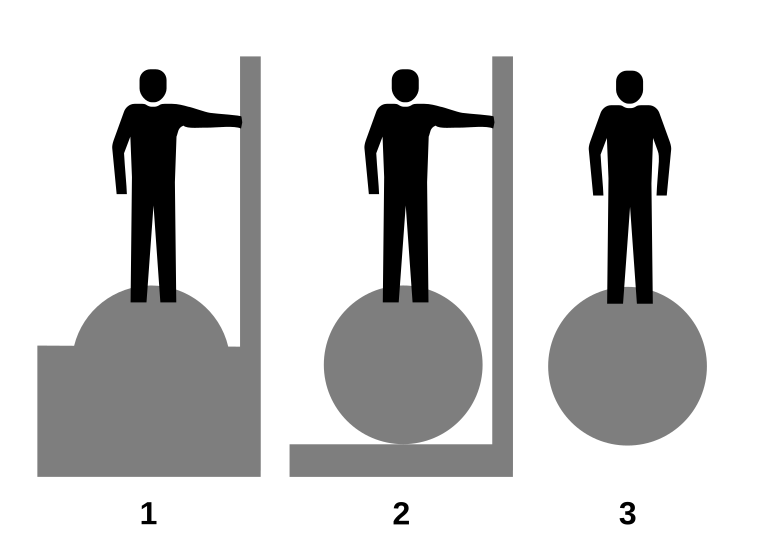
The aim, in the long run, is to be able to stand on the ball essentially indefinitely, without external support. Well-trained circus clowns can often do this, perhaps while juggling. Most of us couldn't even kneel on a ball, let alone stand.
Now consider the arrangement 1: the ball is anchored so that it cannot move, and the man has a wall to lean on. This is how we stand ordinarily, using static forces to support ourselves.
Then consider the arrangement 2: the ball is no longer anchored, but the man has a wall to lean on. This is how things are when we improve our ability to balance: we need less external support.
Finally consider arrangement 3. Once balancing, we cannot support ourselves with static forces as we have nothing to lean on. Instead, we must train our awareness to detect when we are moving away from the upright equilibrium position, and make small, proportionate corrections to move ourselves back to the upright equilibrium position. (This is the sort of thing that the term 'central equilibrium' is meant to refer to.)
In Taiji, to minimise the use of muscular force, we aim to use a generalised balancing technique to move the body and hold it in position. We need to be aware of where each and every joint is, where each and every joint should be, and make small corrective movements to keep ourselves there. We arrange the body so as to avoid direct muscular opposition, so are are always slightly away from vertical, but in a position from which we can easily pull ourselves towards vertical without needing muscular opposition. This is the origin of the semi-crouch position you see Taiji players standing and moving in: to hold the position you need to use only one of each pair of opposing muscles, and then use them as little as possible, essentially slightly stretched. (This slight stretch leads to the elastic way in which mechanical forces are generated and moved through the body.)
Now consider this: is it easier to balance on a ball for one second, or for one minute? In the same way, when using generalised balance to coordinate the body, it is harder to move slowly, without resorting to tensing up muscles and becoming rigid once more. Then, for each point in a transition between postures, and while in postures, we want to keep the minimal use of muscular forces and the elimination of muscular opposition. It is harder, and takes more practice, to do this for a longer period than for a shorter one. Indeed some Taiji schools teaching standing postures, where one will hold a single posture for many minutes, much as a Buddhist monk may sit for hours repeating the same mantram to the exclusion of all other mental activity.
Now, when practising slowly, this should be done with full concentration throughout, and with a deliberate focused Awareness and Intention throughout. Holding undistracted attention to where our body is, and holding the same Intention without distraction, without even being distracted by our body's movement, or the changes in what our eyes see, is a major part of Taiji training. This is no different to how meditators learn to return to the focus of meditation when distracted. In addition, in trying to do this, we will fail again and again, eventually, no matter how good we are. It is just a game of simply resetting and having another go whenever we find ourselves distracted; simply releasing tension when we detect it; and re-acquiring Awareness of our body when we find we have lost it.
Doing this kind of practice slow is harder than just skimming through the postures. Hence we aim to practise the Form slowly. There are plenty of other parts of Taiji practice where we move more rapidly, it is just that slow Form practice isn't one of them.
Credits
- Basic Man Standing: Wikimedia Additions and modifications to this (such as adding wall and ball) John Allsup in Inkscape
